
J0–J7 JAPANESE CURRICULUM
From kana and essential expression to advanced register and professional communication.
Each level shows structured learning, real-world tasks, JLPT reference points and the language used in class, so learners can see where they are, what they are building and what comes next.
LEVEL · TRACK · GOAL
Start with the level outcome, then see how the three learning lines work together.
Your selected level, track and sample lesson remain in the URL, so learners and consultants can review the same pathway together.
The て-form, permission, prohibition, requests and everyday tasks
System progression, travel, life in Japan and JLPT
Make requests in common everyday and travel situations.
Japanese 75–85% · simple English 15–25%
| Course ID | Japanese lesson title / English | Track | Level/JLPT | Core focus | Scene/task | Time | Status | View |
|---|---|---|---|---|---|---|---|---|
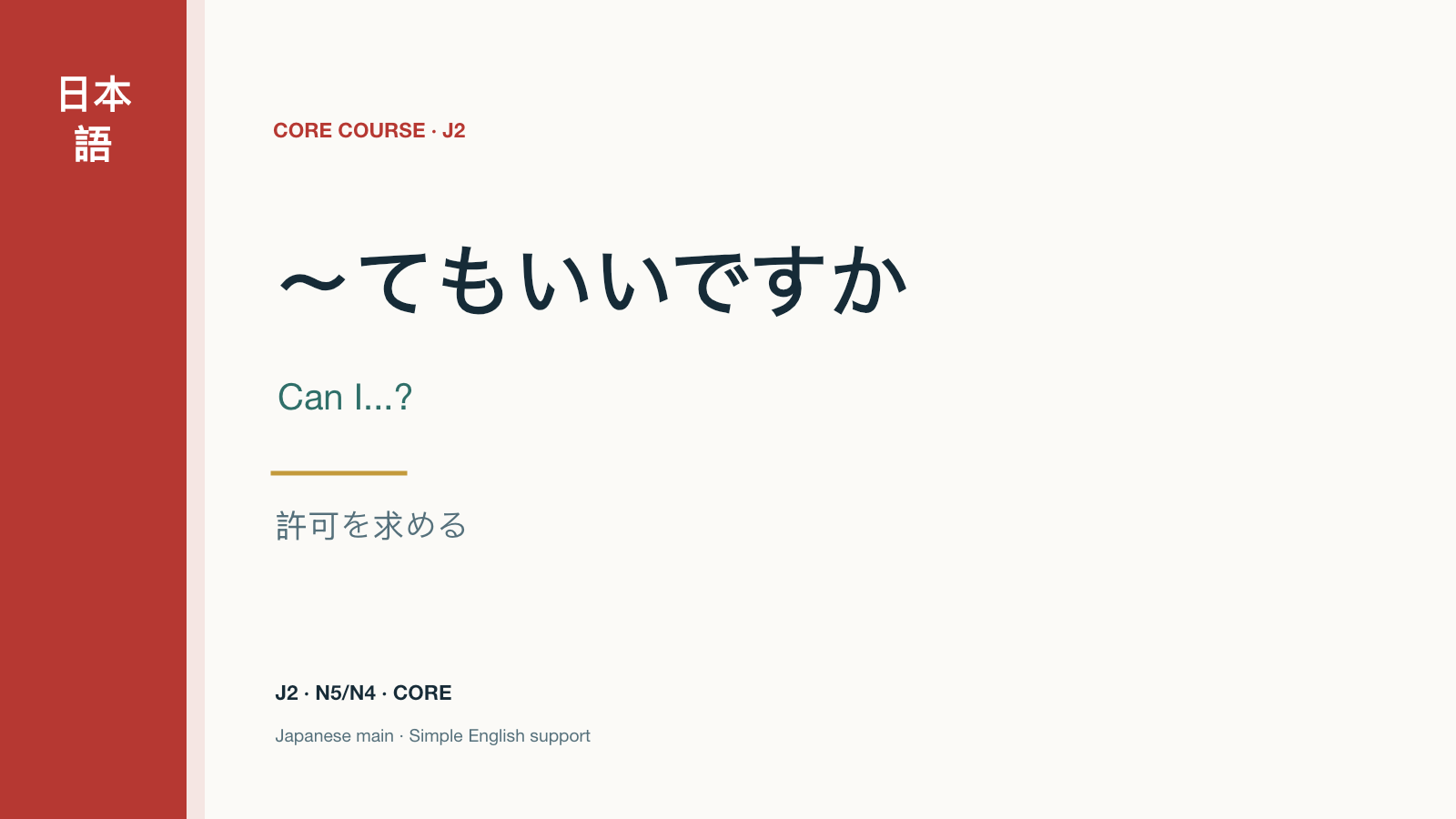
| JC-CORE-J2-GRAMMAR-TEMOII-001 | 〜てもいいですかCan I...? | Core | J2 · N5/N4 | Form, connection, meaning and polite responses in permission requests | Make three personalised requests for different people and settings | 40 min | Published sample lesson |
JC-CORE-J2-GRAMMAR-TEMOII-001〜てもいいですかJ2 · Core+
- English
- Can I...?
- Core focus
- Form, connection, meaning and polite responses in permission requests
- Scene/task
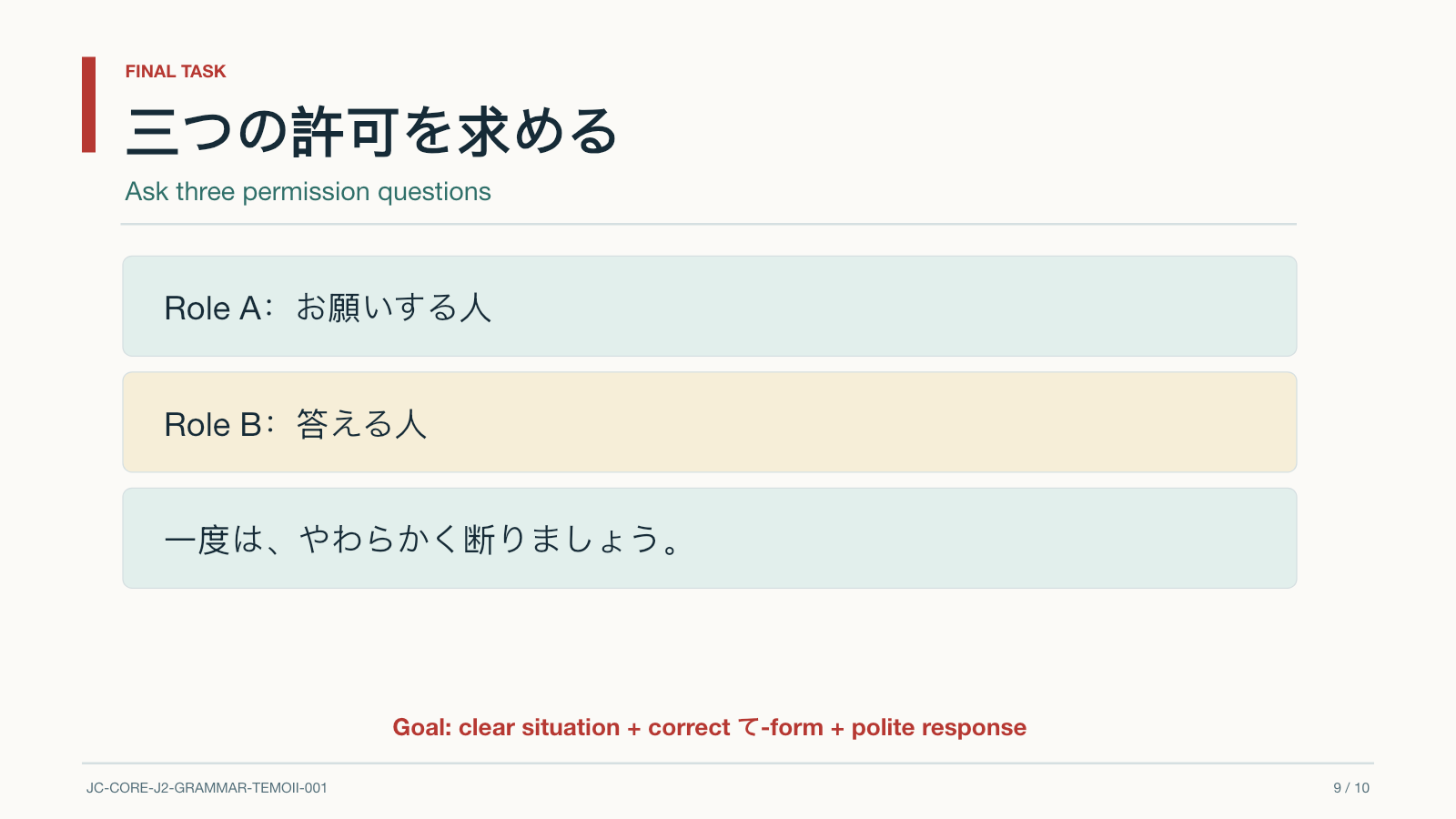
- Make three personalised requests for different people and settings
- Status
- Published sample lesson
REPRESENTATIVE CORE LESSON
JC-CORE-J2-GRAMMAR-TEMOII-001 · 40 MIN〜てもいいですか
Can I...? · J2 · N5/N4 Bridge · Core Course
40-minute learning goals
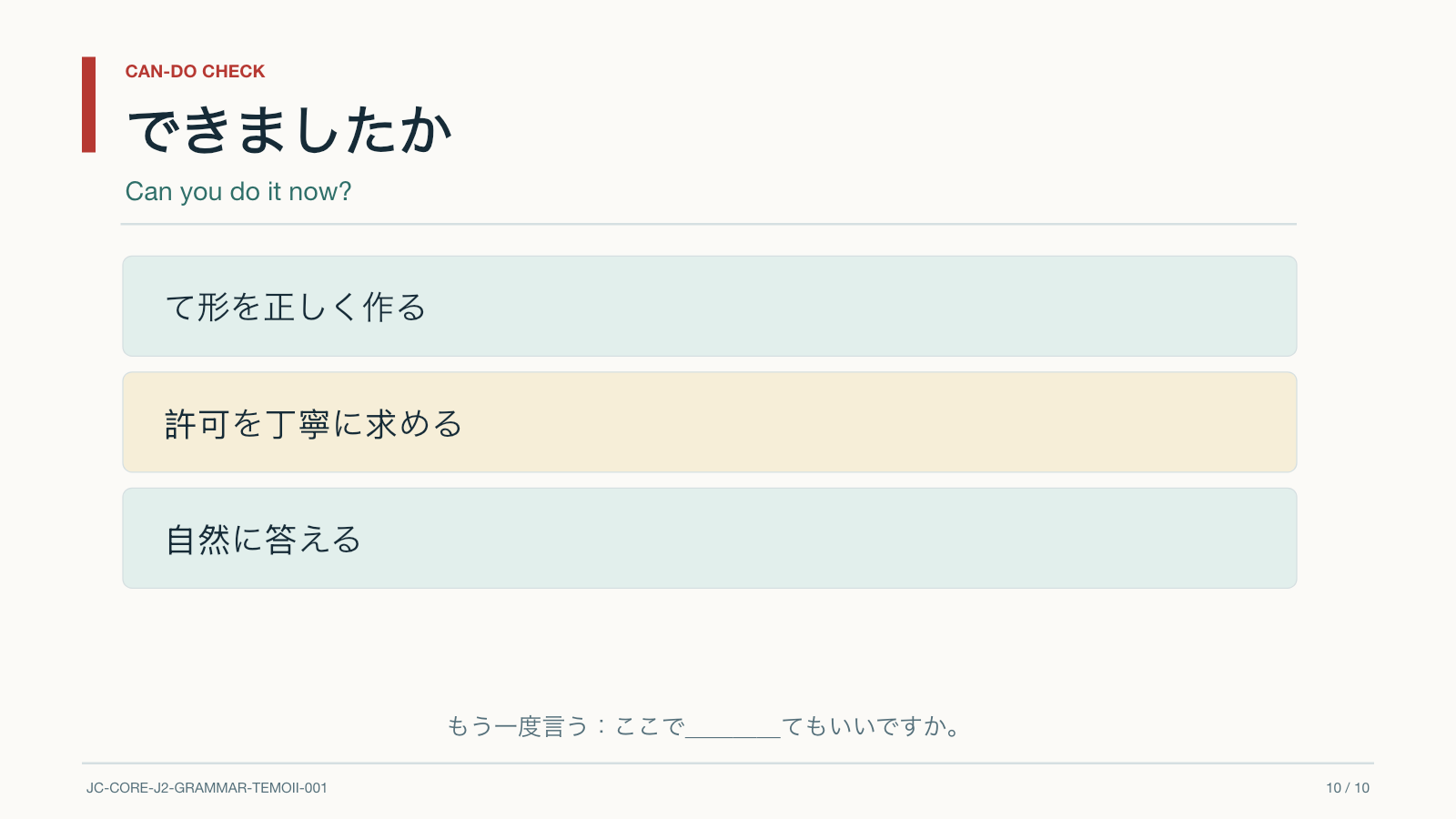
- Understand the meaning and conditions of a permission request.
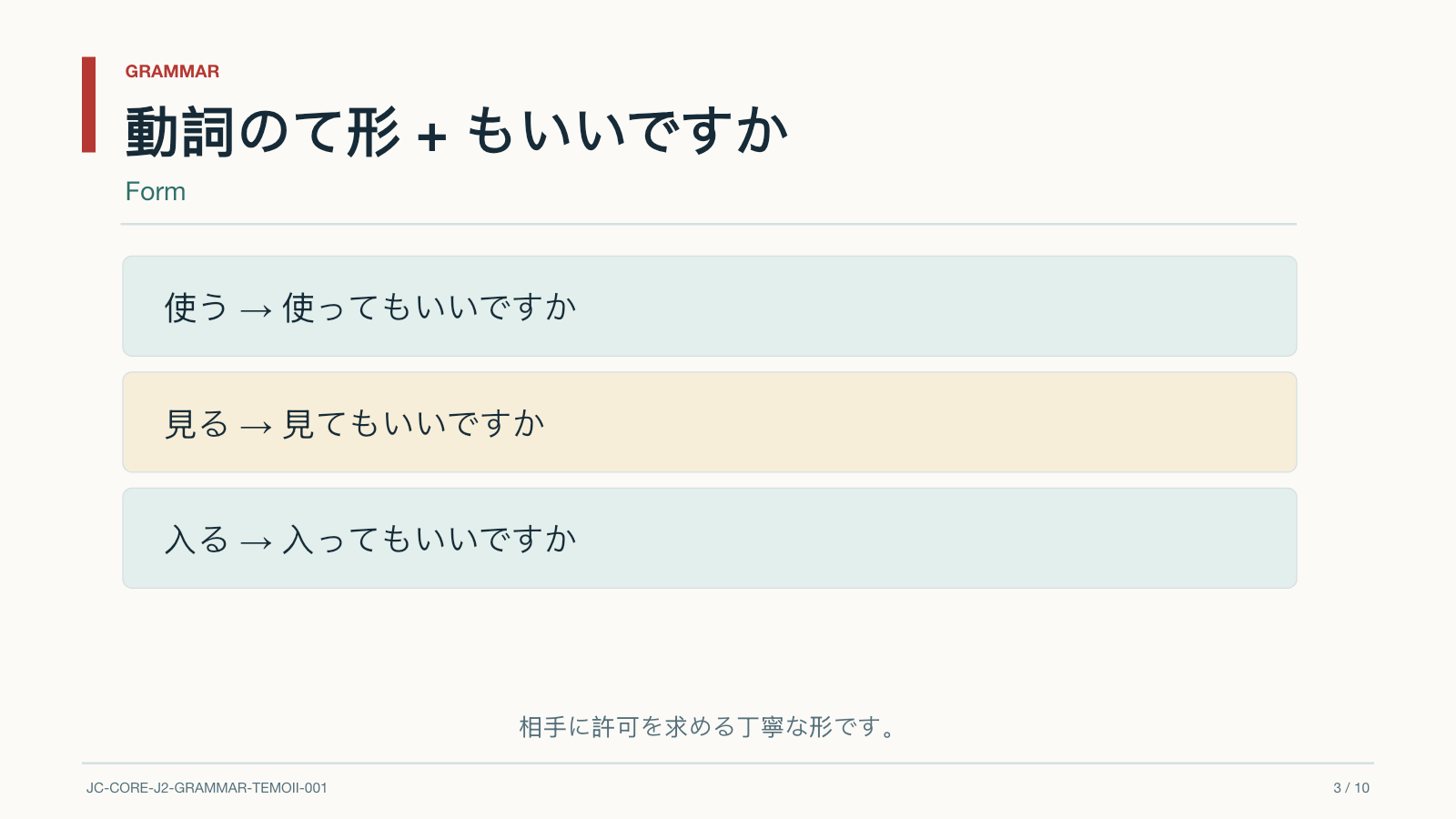
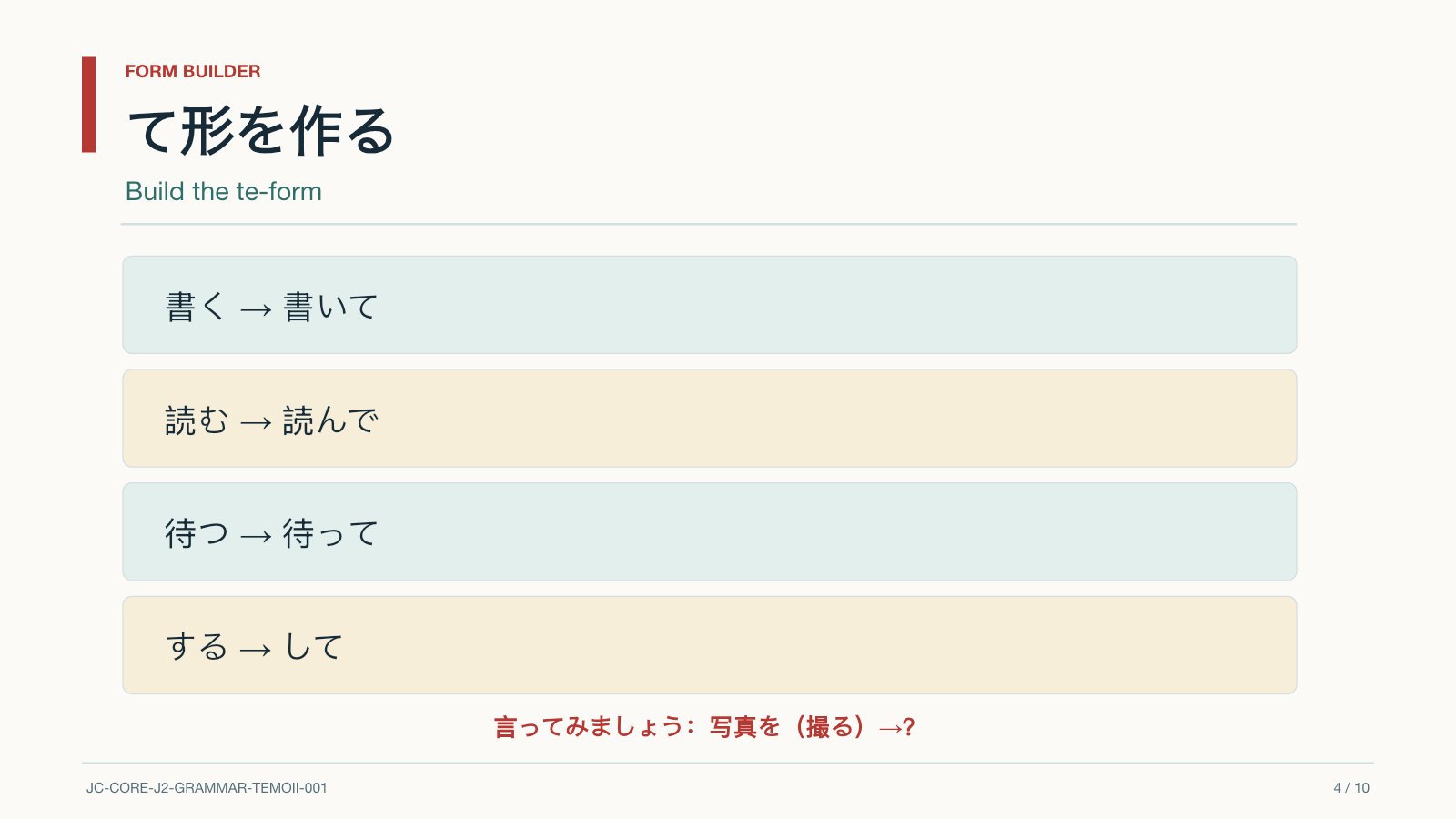
- Form 〜てもいいですか correctly with the verb’s て-form.
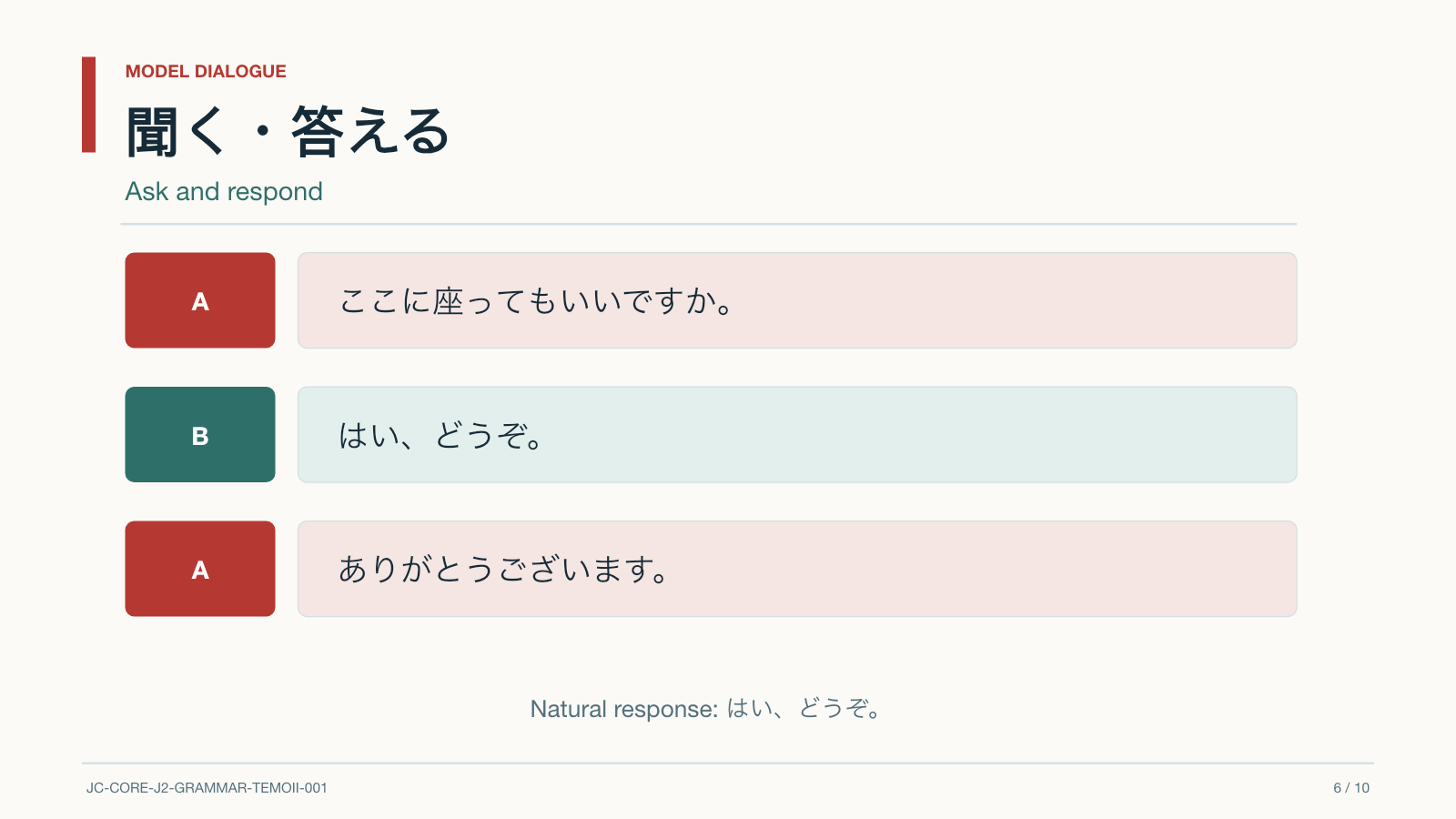
- Understand common answers that grant, refuse or qualify permission.
- Make personalised requests in everyday, travel and classroom situations.
- Maintain an appropriate level of politeness for the person and setting.
Evidence of successful performance
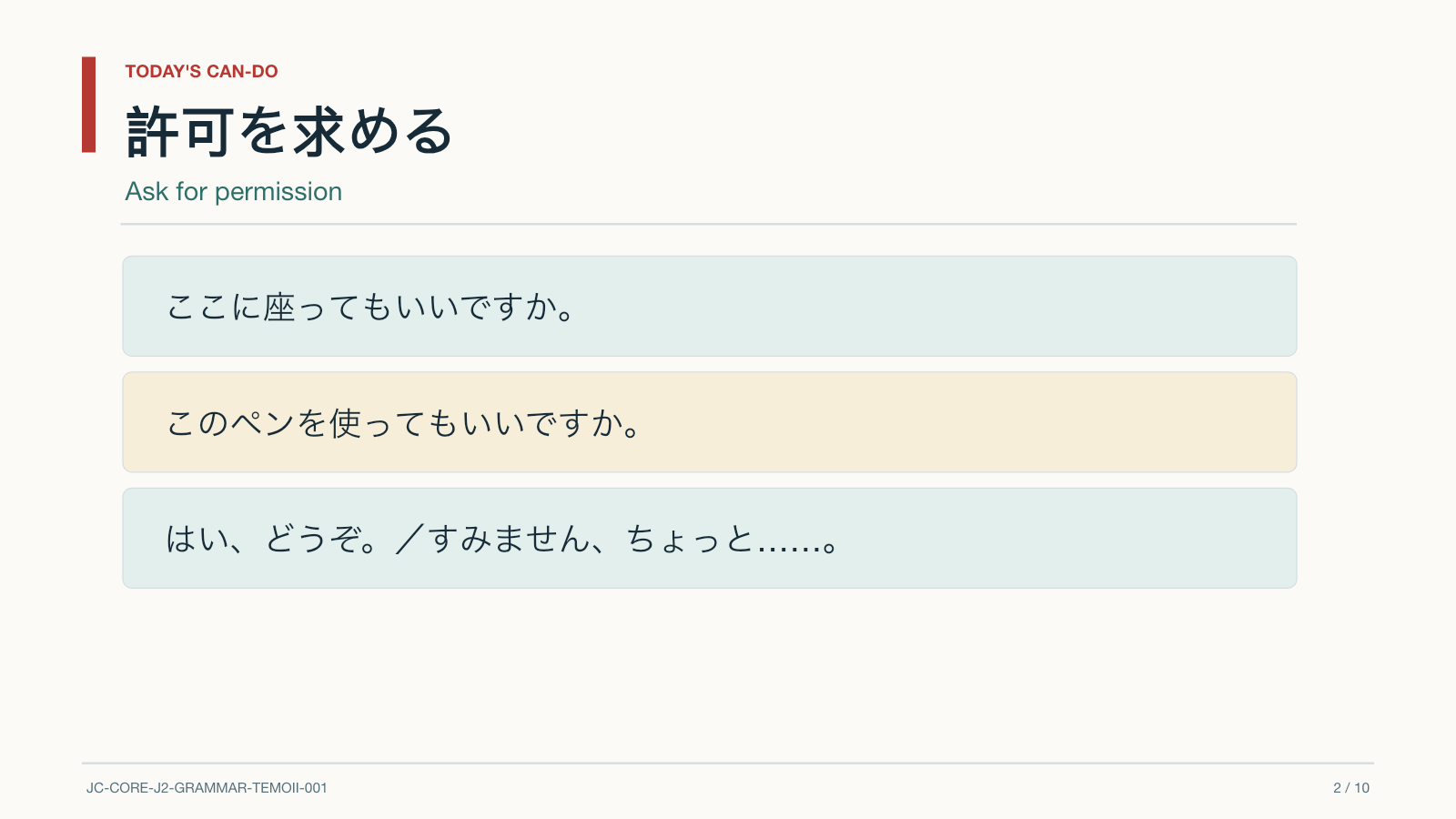
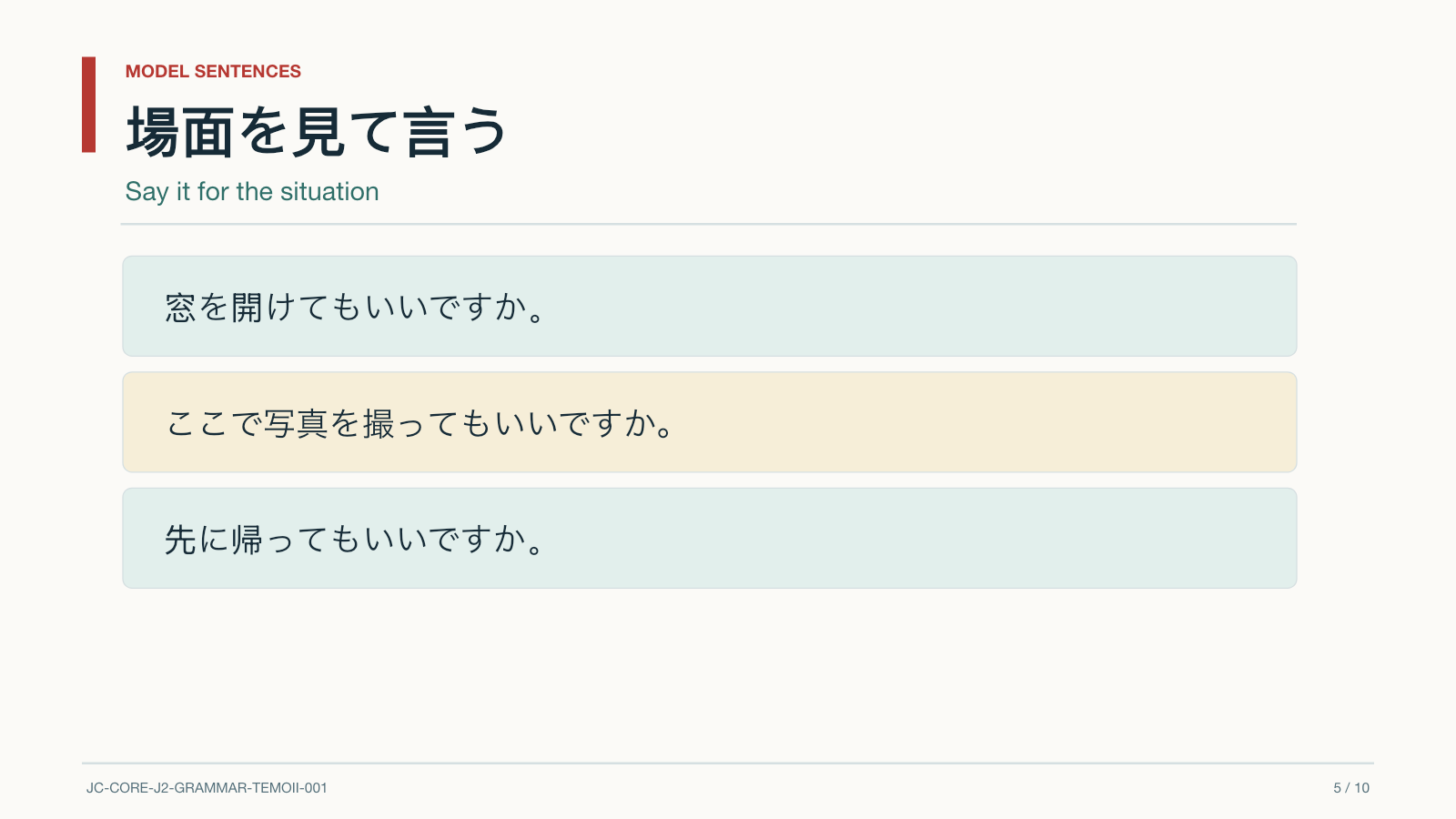
- 窓を開けてもいいですか。
- ここで写真を撮ってもいいですか。
- 先に帰ってもいいですか。
- Understand whether permission is granted, refused or conditional.
- Choose an appropriate expression when the relationship or setting changes.
Common errors
- Incorrect て-form conjugation.
- Omitting も or ですか.
- Confusing a permission request with an expression of ability.
- Using a correct pattern that sounds unnatural for the relationship or setting.
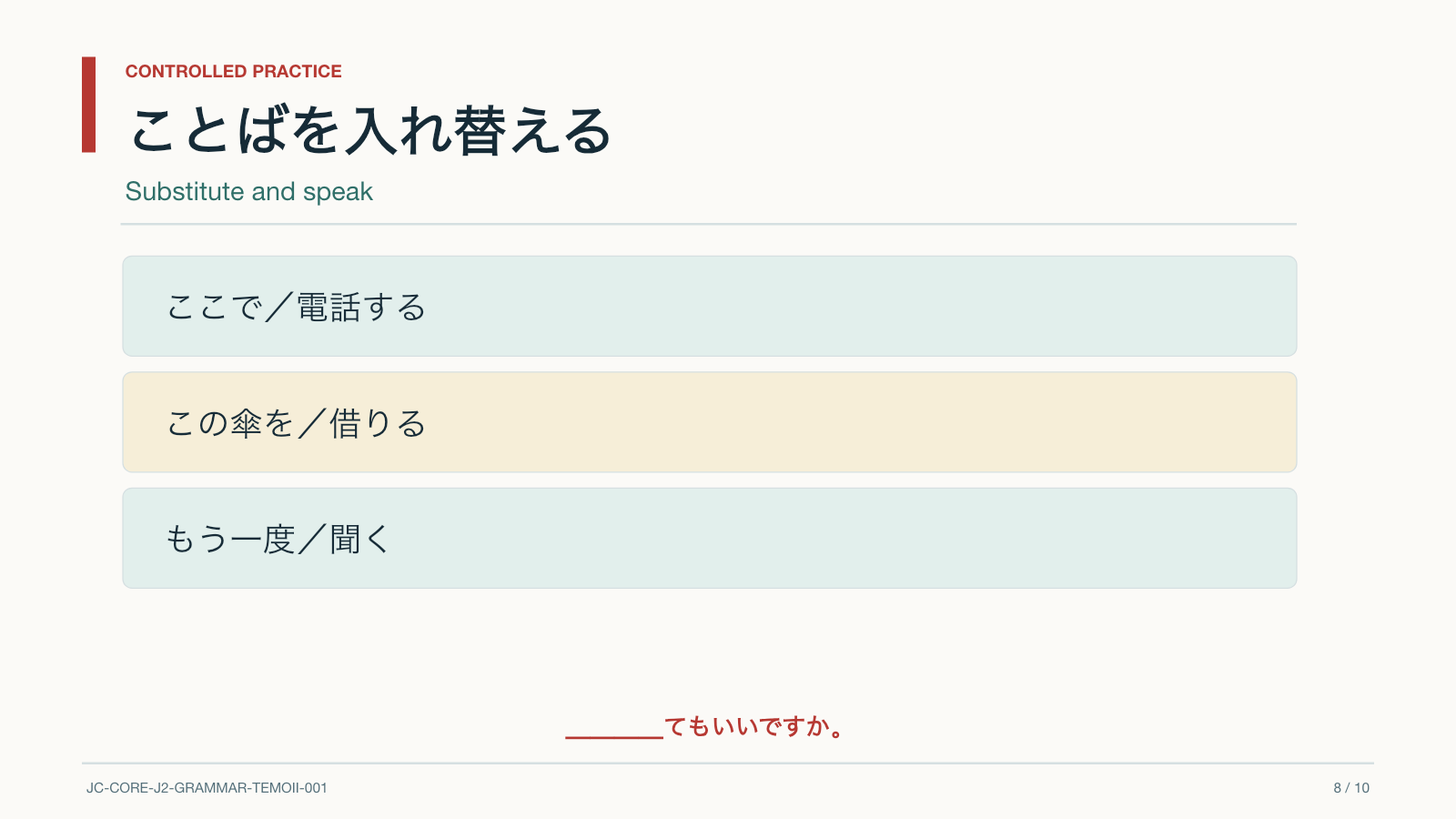
- Memorising one fixed sentence without being able to change the verb or object.
THE 40-MINUTE CORE FLOW
Move from meaning and form to corrected real-world performance.
Every stage connects to a real material page. The flow is not decoration; it represents the teaching actions completed by teacher and learner.
Recall the て-form in a familiar permission context.
The teacher uses the source of an error and response speed to decide whether to model, vary, question or ask for a corrected response.
LEARN · USE · ALIGN
One language point, revisited across three learning lines.
- LEARN · COREJC-CORE-J2-GRAMMAR-TEMOII-001
〜てもいいですか
Learn the form, connection, meaning, response and foundational output.
- USE · SCENEJC-SCENE-J2-TRAVEL-ASKPERMISSION-001
写真を撮ってもいいですか
Complete a real permission request for taking a photo while sightseeing.
- ALIGN · BRIDGEJC-BRIDGE-N5-MINNA-L15-001
N5 Mainstream Textbook No. 15
Align with a reviewed exam and textbook reference.
PREREQUISITE & TRANSFER
Not an isolated item bank, but a connected progression of knowledge.
- BEFOREForm the verb’s て-form correctly使う → 使って/見る → 見て
- NOW〜てもいいですかRequest permission and understand the response
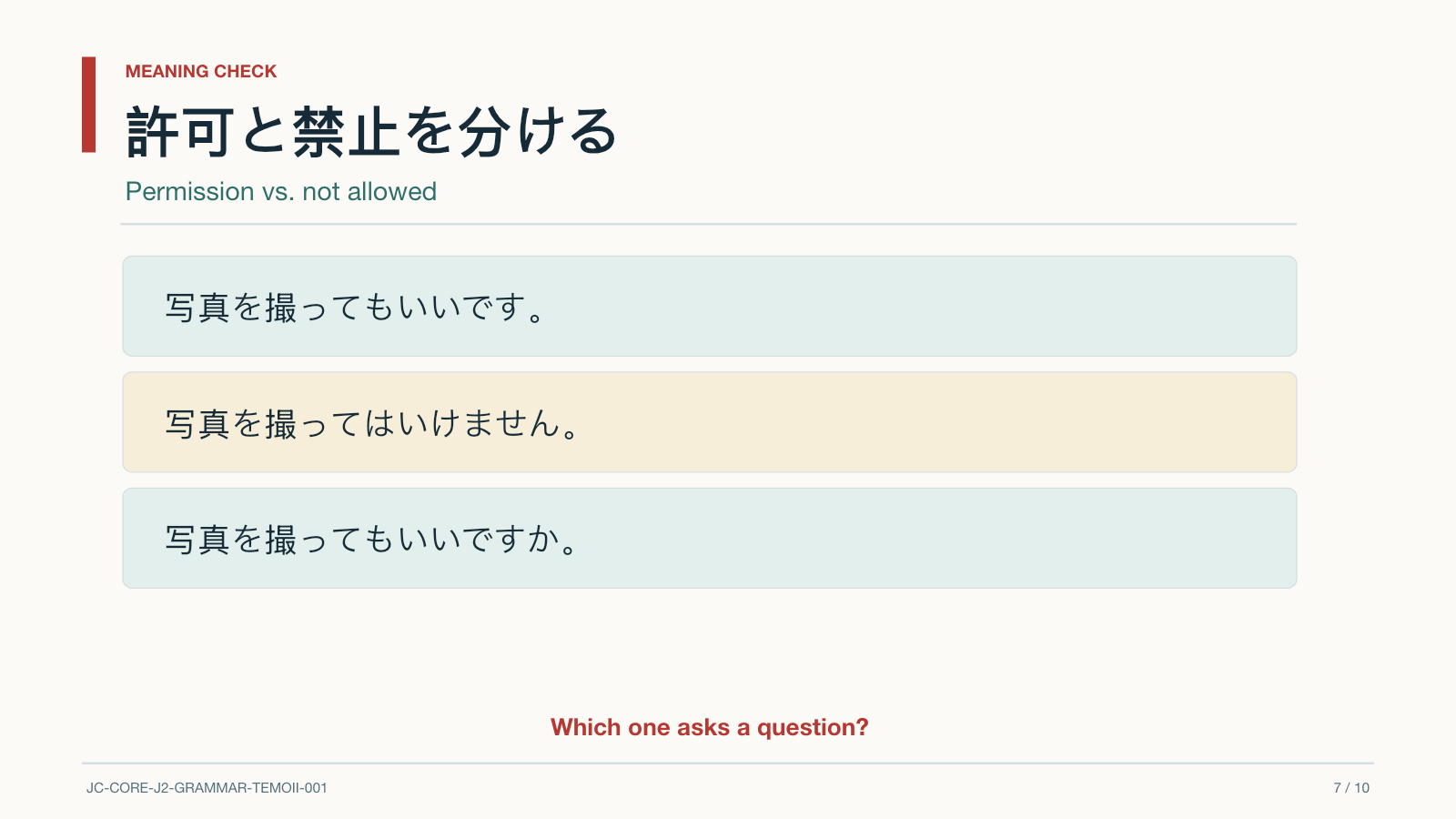
- NEXT〜てはいけませんUnderstand prohibition and differences in response
- LATERRelationship and registerAdjust expression for a friend, teacher or client
GRAMMAR ATLAS · TRANSPARENT STATUS
Imported reference material is only the beginning. A lesson enters the curriculum only after editorial review.
Japanese Compass maintains an N5–N1 grammar and sentence-pattern reference. Every item must document connection, conjugation, polite and plain forms, written and spoken use, register, situation, JLPT reference and planned recurrence before editorial approval.
FIND YOUR STARTING POINT
Your goal should not have to find its own way through a fixed textbook list.
We first clarify level and goal, then combine Core, Scene and Bridge around what you need.