
iMentoris · ENGLISH-FIRST SINGAPORE MATH
Singapore Math builds thinkers, not just correct answers.
Learners use hands-on experience, visuals and models to see mathematical relationships, then explain, check and transfer their thinking. When a problem changes, they still know where to begin. Live teachers guide the P1–P6 pathway with English-medium student materials.

Why learn Singapore Math? Understand what changes, not just what looks familiar.
Singapore Math puts problem solving at the centre. Learners understand concepts and relationships, choose a method, build a model, explain their reasoning and carry the same thinking into a new problem.
Understand the problem
Identify what is known, unknown and actually being asked.
See the relationship
Turn language into a visual or model instead of guessing from keywords.
Transfer the method
Understand why a method works, then use it in a new context.
Which learners can benefit from Singapore Math?
It is not only for learners who already score well. These patterns often signal a need for a clearer path to understanding—not another stack of repeated questions.
Turn the language into a picture or model to reveal knowns, unknowns and relationships.
Compare representations and strategies, then transfer understanding to a new problem.
Use live teacher questions to give a complete explanation and check the result.
Use visual scaffolds, actions and mathematical sentence frames while building English maths expression.
ONE REAL PROBLEM
One comparison problem: pair it, inspect it, say it, and prove it.
These are not five disconnected illustrations. They are pages from one formal lesson, showing how a learner moves from an intuitive judgement to a fair comparison.
01/ 05
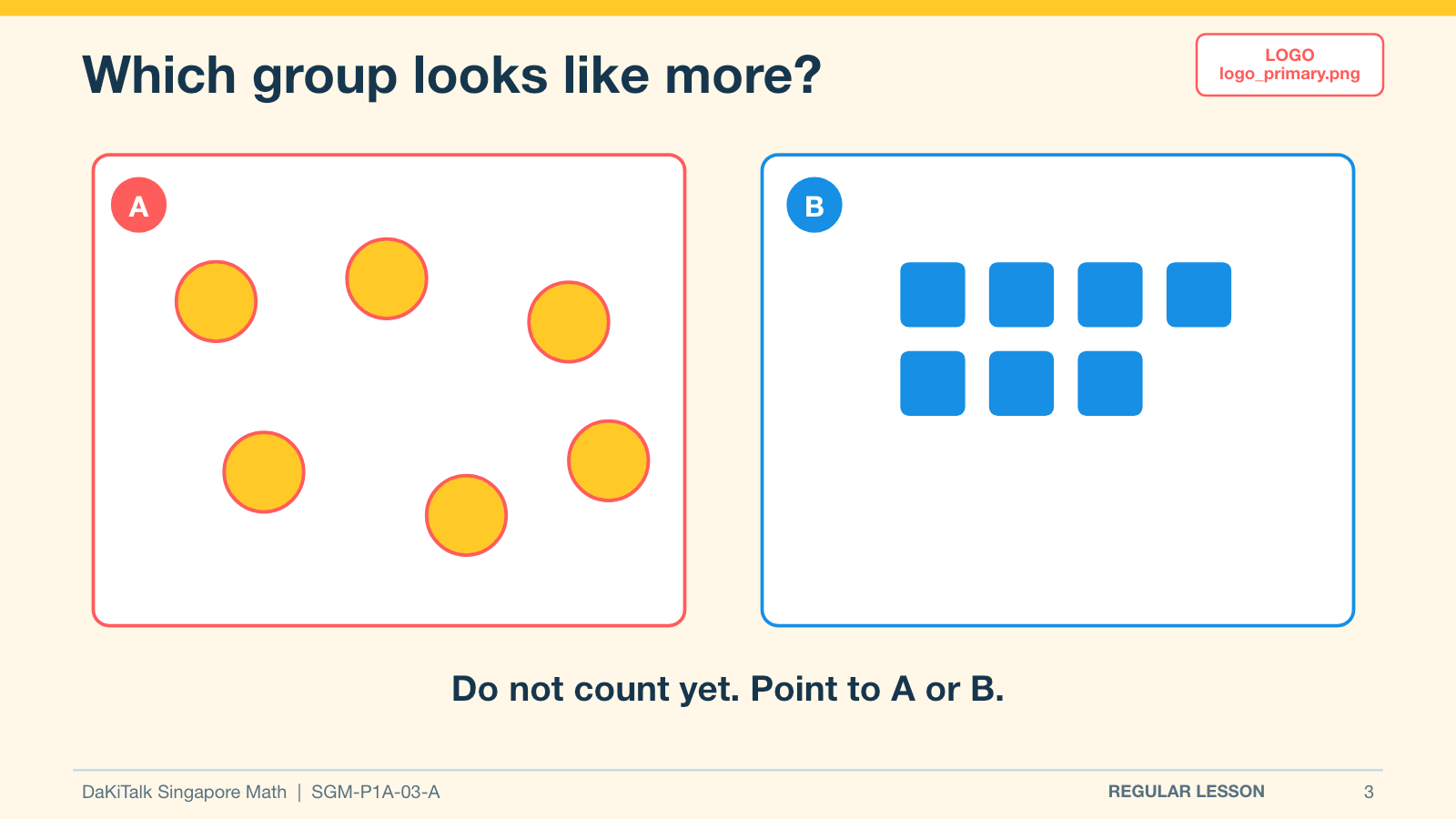
Begin with an intuitive look
Before counting, choose the group that looks like it has more and explain the first impression.
TEACHER PROMPTWhich group looks like more? Do not count yet.Explore this 40-minute lesson →
VISIBLE LEARNING EVIDENCE
Calculation is the starting point. We look for five kinds of learning evidence.
- RRepresent
Turn the problem into a model or quantity
- MModel
Choose the right model and relationship
- EExplain
Explain the reasoning in a complete sentence
- CCheck
Show why the answer is reasonable
- TTransfer
Transfer the method to a new situation
CPA, MADE VISIBLE
Handle it. See it. Then express it mathematically.
The same problem moves between Concrete, Pictorial and Abstract representations. The teacher identifies where understanding breaks down, then returns to the model, asks another question or moves into independent practice.
Hands-on representation
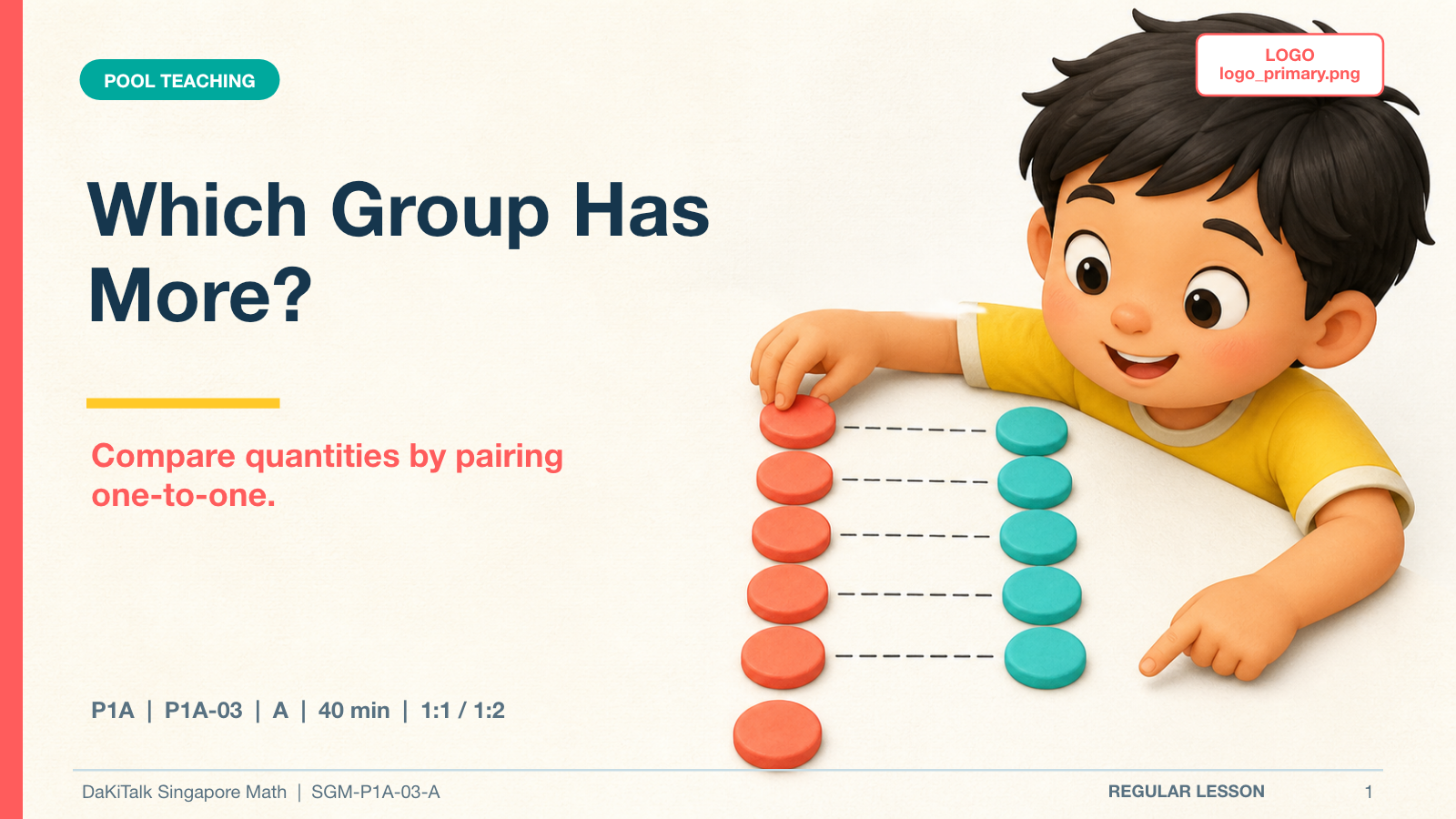
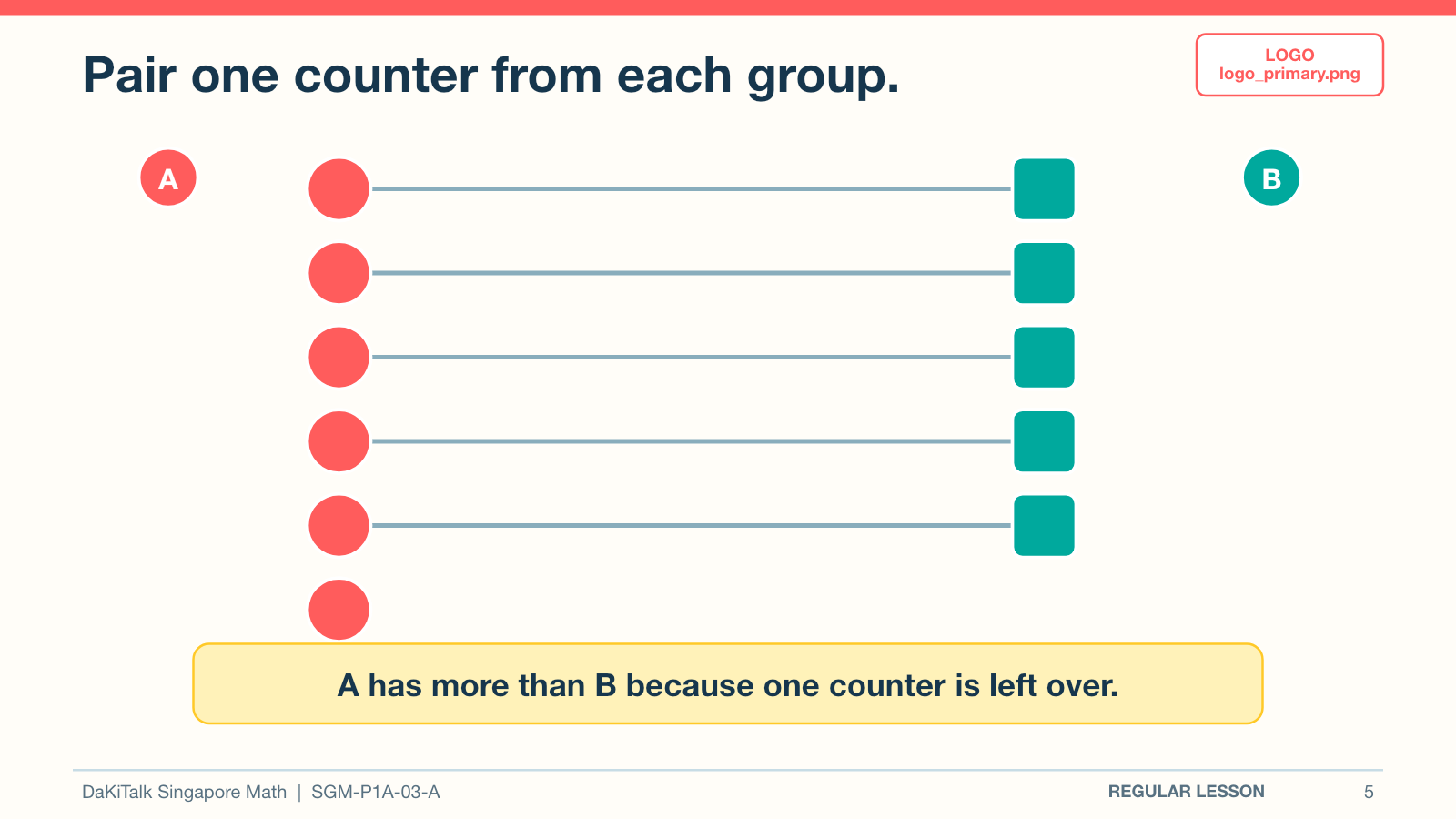
Use physical counters to pair the groups one-to-one and check that every object has a match.
P1–P6 LEVEL EXPLORER
A visible P1–P6 path from number sense to integrated reasoning.
Each level includes A and B semesters, with Core, Mastery and Assessment forming a traceable learning cycle.
0–100, number bonds, the meaning of addition and subtraction, money, time, shapes and graphs
Explain a number relationship with objects and pictures
ONE VERIFIABLE SEMESTER
Complete a verifiable learning cycle—not a fixed list of materials.
P1–P6 remains the long-term backbone. Families see one clear, achievable stage at a time, with evidence of learning.
Build concepts and methods
Mixed practice, misconception repair and transfer
Independent performance and next-step guidance
ANATOMY OF A LIVE CLASS
A clear lesson rhythm, adjusted through live evidence.
Six phases make up 40 minutes. Use the timeline to see how each phase works through the real SGM-P1A-03-A material.
Swipe to explore the full lesson rhythm
04 min· Launch
Begin with an intuitive comparison to hear how the learner is already thinking.
Prerequisite Check · Visual EstimateWHY A HUMAN TEACHER
A teacher does not simply present material. A teacher identifies why the learner thinks that way.
The same wrong answer can come from the concept, comparison order, representation or language. A live teacher identifies the cause from the learner’s actions and responses.
STUDENT This row is longer, so it has more.
TEACHER Does spacing change the quantity? Pair one counter from each group.
STUDENT · REVISED Spacing changes the row, not the quantity. The groups have the same number.
- 01 Diagnose
- 02 Question
- 03 Change the representation
- 04 Choose the next problem
REPORT SAMPLE
Parents see more than completion. They see what the learner should work on next.
This is a report sample. It is not an automatically generated system report and does not represent a real learner’s result.
- Concept
- One-to-one correspondence and equal quantities Secure
- Representation
- Pictures and one-to-one pairing Independent
- Explanation
- A complete more/fewer/same sentence Prompt needed
- Check
- Compare correctly even when the arrangement changes Secure
- Transfer
- Connect to >, <, and = Next step
COMMON QUESTIONS
Important details, clear before you begin.
We do not invent results, testimonials or features that are not yet live. Final group size, pricing and service terms follow the launched programme.
The goal is not simply another set of exercises, but a reusable way to solve problems. Learners move from hands-on experience to pictures and models, then explain, check and transfer the mathematical relationship to a new problem.
Learners who can calculate but get stuck on word problems, lose the method when wording changes, cannot explain why, or need abstract relationships made more visible may benefit. Fit and starting point are recommended after a trial and level analysis.
The current pathway covers P1–P6, corresponding broadly to Primary 1 through Primary 6. The starting point considers both school year and the concepts the learner can already apply in actual problem solving.
Singapore Math currently offers one-to-one and one-to-two lessons. One-to-one supports close observation and individual questioning; one-to-two adds peer explanation and comparison of methods. Availability follows the current course product.
The course is aligned to the direction of Singapore MOE primary mathematics and uses materials developed by the iMentoris platform. It does not simply adopt a complete textbook series from a single publisher.
Lessons do more than check an answer. They observe how learners represent, model, explain, verify and transfer. CPA, model methods and live questioning make the mathematical relationships and thinking behind calculation visible.
The current booking window is 09:00–22:00 Beijing time, with lessons bookable up to one month ahead. The live booking calendar shows the times currently available.
No. The course refers to Singapore MOE curriculum direction and is independently developed by the platform. It does not claim authorisation, certification or affiliation with Singapore MOE or any textbook publisher.
40-MINUTE TRIAL
See how your child thinks before deciding where to begin.
The trial observes representation, explanation and checking, then recommends a suitable P1–P6 starting point.
- See how your child builds a model
- Separate the mathematics starting point from the English load
- Discuss the learning stage after the trial